Every day, the body is attacked by bacteria, viruses, fungi and parasites, yet most of the time we stay healthy. That is the work of the immune system, a team of cells, proteins and organs, many of which live in and travel through the lymphatic system. Vaccines, antibiotics, allergy medicines and many modern drugs all work by understanding this system.
Part 1: The lymphatic system
Blood capillaries leak a little fluid into the tissues all the time. Most of it goes back into the blood, but about 2 to 3 litres a day is left behind. The lymphatic system collects this fluid, now called lymph, cleans it and returns it to the blood. Without it, the tissues would swell (oedema).
Functions
- Fluid balance: returns leaked fluid and proteins to the blood.
- Fat absorption: small lymph vessels in the intestine (lacteals) absorb dietary fats.
- Immunity: filters lymph through lymph nodes, where immune cells trap and destroy germs.
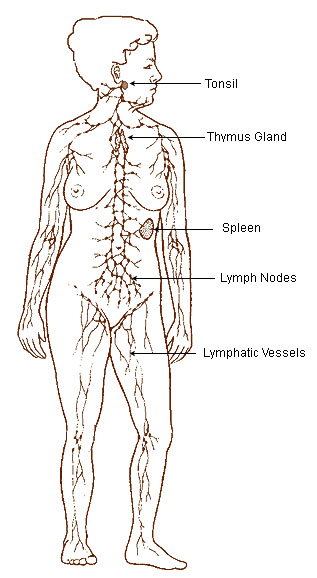
Parts of the lymphatic system
| Part | Description and function |
|---|---|
| Lymph | Clear, watery fluid containing white blood cells (mainly lymphocytes). |
| Lymphatic vessels | A network of tubes, similar to veins, with valves. Lymph moves through them by muscle squeezing and breathing movements; there is no pump. They drain into the thoracic duct and right lymphatic duct, which empty into large veins near the neck. |
| Lymph nodes | Small, bean-shaped filters (about 600 in the body), clustered in the neck, armpits, groin and abdomen. They contain lymphocytes that attack germs. Swollen, tender nodes ("glands") during an infection show the immune system at work. |
| Spleen | The largest lymphatic organ, in the upper left abdomen. Filters blood, removes old red blood cells and contains many immune cells. People without a spleen are more vulnerable to some infections. |
| Thymus | In the chest behind the breastbone. Where T lymphocytes mature. It is large in children and shrinks after puberty. |
| Red bone marrow | Where all blood cells, including lymphocytes, are made. B lymphocytes also mature here. |
| Tonsils, adenoids, appendix and Peyer's patches | Lymphatic tissue that guards the entry points of the mouth, nose and gut. |
Primary lymphoid organs (where lymphocytes are made and mature): bone marrow and thymus. Secondary lymphoid organs (where they meet germs): lymph nodes, spleen, tonsils and gut lymphatic tissue.
Part 2: The immune system
The immune system has two main lines of defence that work together:
| Innate (non-specific) immunity | Adaptive (specific) immunity | |
|---|---|---|
| Present from | Birth | Develops after exposure to a germ or vaccine |
| Speed | Immediate (minutes to hours) | Slower at first (days) |
| Target | Any invader in the same general way | One specific germ (antigen) |
| Memory | No | Yes: responds faster and stronger the next time |
| Main players | Skin, mucus, neutrophils, macrophages, NK cells, fever, inflammation | B cells (antibodies) and T cells |
First line of defence: physical and chemical barriers
- Skin: a tough, waterproof barrier.
- Mucous membranes and mucus: trap germs in the nose, airways and gut; cilia sweep them away.
- Chemicals: stomach acid, lysozyme in tears and saliva, and acidic skin secretions kill many germs.
- Normal flora: friendly bacteria on the skin and in the gut compete with harmful ones.
Second line of defence: innate immune responses
- Phagocytes ("eating cells"): neutrophils (the most common white blood cells, first to arrive) and macrophages engulf and digest germs.
- Natural killer (NK) cells: destroy virus-infected and cancer cells.
- Inflammation: damaged tissue releases chemicals such as histamine, causing redness, heat, swelling and pain. This brings more blood and immune cells to the area.
- Fever: a higher body temperature slows germ growth and speeds up immune reactions.
- Complement proteins and interferons: blood proteins that help destroy germs and block virus spread.
Third line of defence: adaptive immunity
An antigen is any molecule the immune system recognises as foreign, usually a protein on the surface of a germ. Adaptive immunity uses two kinds of lymphocytes:
| Cell | Type of immunity | How it works |
|---|---|---|
| B lymphocytes (B cells) | Humoral (antibody-mediated) | When activated, B cells become plasma cells that make antibodies. Antibodies bind to antigens, neutralise toxins and mark germs for destruction. |
| Helper T cells (CD4) | Cell-mediated | The "coordinators": they activate B cells and other T cells. HIV destroys these cells, weakening the whole immune system. |
| Cytotoxic T cells (CD8) | Cell-mediated | Directly kill virus-infected cells and cancer cells. |
| Memory B and T cells | Both | Remember a germ for years, giving long-lasting protection. |
Antibodies (immunoglobulins)
| Type | Key facts |
|---|---|
| IgG | Most common (about 75%); the only one that crosses the placenta to protect the baby; main antibody in the secondary response. |
| IgA | Found in tears, saliva, mucus and breast milk; protects mucous membranes. |
| IgM | The first antibody made in a new infection; large (pentamer). |
| IgE | Involved in allergies and defence against parasites; triggers histamine release from mast cells. |
| IgD | Found on the surface of B cells; helps activate them. |
Memory trick: "GAMED" for the five types.
Types of acquired immunity
| Active (body makes its own antibodies, long-lasting) | Passive (ready-made antibodies, short-lived) | |
|---|---|---|
| Natural | Getting the infection (e.g. chickenpox) | Antibodies from mother to baby via placenta or breast milk |
| Artificial | Vaccination | Injection of antibodies, e.g. anti-rabies immunoglobulin or anti-tetanus immunoglobulin |
How vaccines work: a vaccine contains a harmless form or part of a germ. The immune system responds and makes memory cells, so if the real germ arrives later, the body fights it off quickly before you become ill.
When the immune system goes wrong
- Allergy (hypersensitivity): an overreaction to harmless things like pollen, dust or certain foods, driven by IgE and histamine. The most severe form is anaphylaxis, a life-threatening emergency.
- Autoimmune disease: the immune system attacks the body's own tissues, e.g. type 1 diabetes, rheumatoid arthritis, lupus.
- Immunodeficiency: a weak immune system, e.g. HIV/AIDS, or caused by chemotherapy or long-term steroids.
- Transplant rejection: the immune system attacks a transplanted organ.
- Lymphatic system returns fluid to the blood, absorbs fats (lacteals) and supports immunity.
- Primary lymphoid organs: bone marrow (B cells mature) and thymus (T cells mature).
- Spleen = largest lymphatic organ; filters blood.
- Innate = fast, non-specific, no memory. Adaptive = specific, with memory.
- B cells make antibodies (humoral). T cells: helper (CD4) and cytotoxic (CD8) (cell-mediated).
- Antibodies "GAMED": IgG crosses placenta, IgA in secretions, IgM first, IgE allergy.
- Vaccination = artificial active immunity. Antibody injection = artificial passive immunity.
- Neutrophils are the most common white blood cells.
- Vaccines: pharmacists often give and store vaccines; most need refrigeration at 2 to 8 °C (the "cold chain").
- Allergies: antihistamines (cetirizine, loratadine, fexofenadine) block histamine. Adrenaline (epinephrine) injection is the first-line treatment for anaphylaxis.
- Immunosuppressants: corticosteroids, ciclosporin, tacrolimus and azathioprine prevent transplant rejection and treat autoimmune diseases, but raise infection risk.
- Biologics: monoclonal antibodies (adalimumab, infliximab, rituximab) target specific immune molecules in diseases like rheumatoid arthritis and some cancers.
- HIV: antiretroviral therapy (ART) keeps the virus suppressed and protects CD4 cells.
- Antibiotics help the immune system clear bacterial infections; they do not work against viruses, which is a key message for patient counselling.
No comments:
Post a Comment