The human ear can detect sounds as quiet as a whisper and as loud as a jet engine, and pick out a single voice in a noisy room. Hidden deep inside it is also the body's balance system, which is why an ear infection can make you dizzy. This post explains the three parts of the ear, how hearing and balance work, and the ear problems and medicines pharmacy students commonly meet.
The three parts of the ear
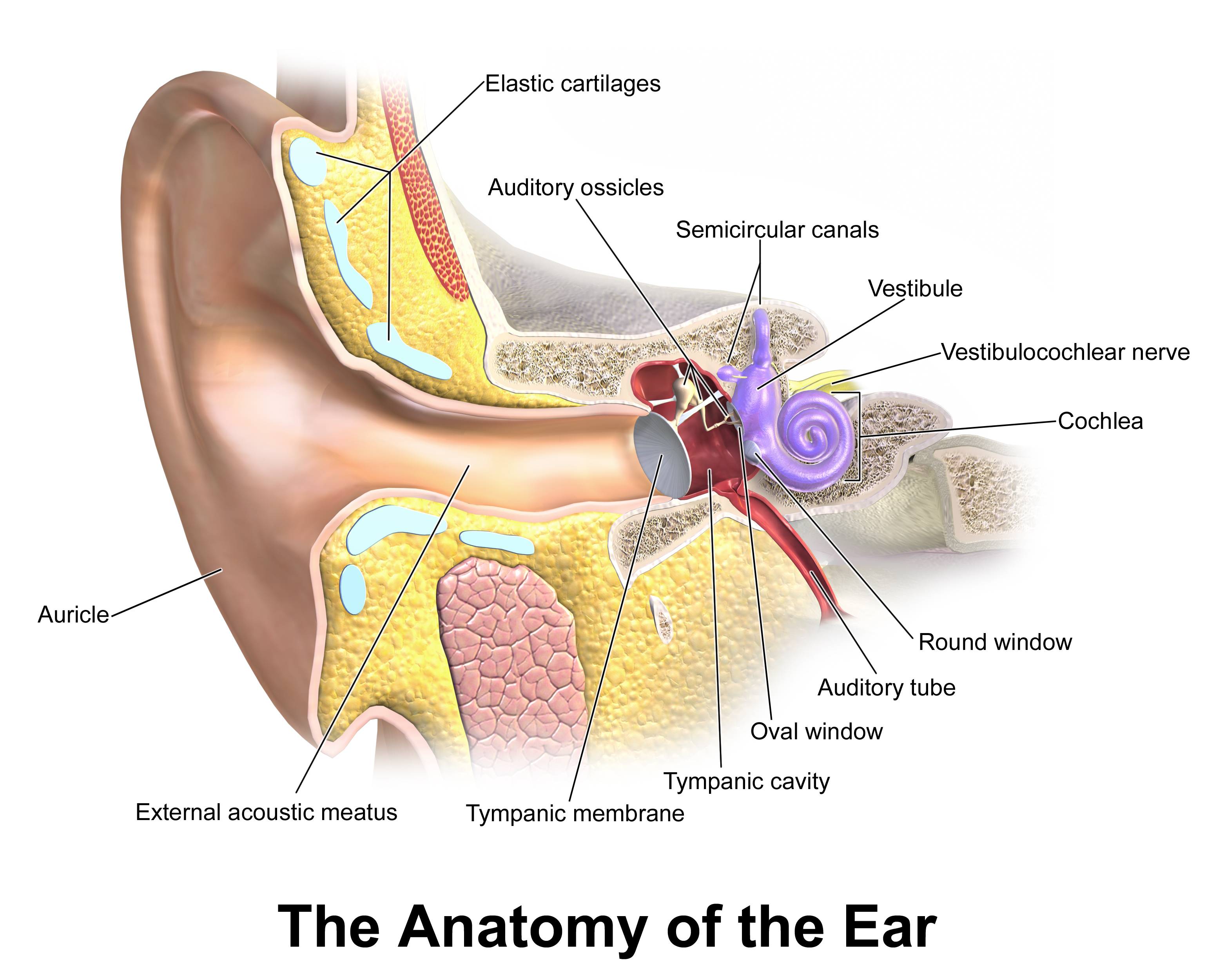
| Part | Contains | Main job |
|---|---|---|
| Outer (external) ear | Pinna (auricle), ear canal | Collects sound and directs it to the eardrum |
| Middle ear | Eardrum, three ossicles, Eustachian tube | Amplifies sound and passes it to the inner ear |
| Inner ear | Cochlea, vestibule, semicircular canals | Turns sound into nerve signals; senses balance |
1. The outer ear
- Pinna (auricle): the visible part, made of skin and flexible cartilage. Its shape funnels sound waves into the ear and helps us tell where sounds come from.
- External auditory canal (ear canal): a tube about 2.5 cm long leading to the eardrum. Glands in its lining make earwax (cerumen), which traps dust, repels water and helps protect against infection. Earwax normally moves out on its own; cotton buds can push it deeper.
2. The middle ear
An air-filled space inside the temporal bone.
- Tympanic membrane (eardrum): a thin membrane that vibrates when sound waves hit it. It separates the outer and middle ear.
- Ossicles: the three smallest bones in the body, linked in a chain:
- Malleus (hammer): attached to the eardrum.
- Incus (anvil): in the middle.
- Stapes (stirrup): the smallest bone in the body; it pushes on the oval window of the inner ear.
- Eustachian (auditory) tube: connects the middle ear to the back of the throat. It equalises air pressure on both sides of the eardrum, which is why yawning or swallowing "pops" your ears in an aeroplane. In children it is shorter and more horizontal, so throat infections spread to the middle ear more easily.
3. The inner ear
A maze of fluid-filled tubes deep in the skull, called the labyrinth. It has two systems:
- Cochlea (for hearing): a snail-shaped tube coiled about 2.5 turns. Inside is the organ of Corti, lined with about 15,000 to 20,000 tiny hair cells, the real sound receptors.
- Vestibular system (for balance): the vestibule (containing the utricle and saccule) and three semicircular canals.
The vestibulocochlear nerve (cranial nerve VIII) carries signals from both systems to the brain.
How we hear, step by step
- The pinna collects sound waves and sends them down the ear canal.
- The waves make the eardrum vibrate.
- The malleus, incus and stapes pass on and amplify the vibrations.
- The stapes pushes on the oval window, creating waves in the fluid of the cochlea.
- The fluid waves bend the hair cells in the organ of Corti, which turn the movement into electrical signals.
- The cochlear nerve carries the signals to the auditory cortex in the temporal lobe of the brain, where they are recognised as sound.
Pitch: hair cells near the base of the cochlea respond to high-pitched sounds, and those near the tip respond to low-pitched sounds. Young people can hear roughly 20 to 20,000 Hz; the top of this range falls with age. Loudness is measured in decibels (dB). Regular exposure to sounds above about 85 dB, such as loud music through earphones, can permanently damage hair cells, and they do not grow back.
How balance works
| Structure | What it senses | Example |
|---|---|---|
| Semicircular canals (three, at right angles to each other) | Rotational movement of the head (turning, nodding, tilting) | Spinning around, shaking your head |
| Utricle and saccule | Head position relative to gravity and straight-line movement | Tilting your head, moving forward in a car or up in a lift |
Fluid in these structures moves when the head moves, bending hair cells that send signals to the brain. The utricle and saccule contain tiny crystals of calcium carbonate (otoliths) that make them sensitive to gravity. The brain combines this information with signals from the eyes and from muscles and joints to keep us balanced. When these signals do not match, for example reading in a moving car, we can feel motion sickness.
Common ear problems
- Otitis externa ("swimmer's ear"): infection of the ear canal, causing pain and itching.
- Otitis media: middle ear infection, very common in children, often after a cold; causes ear pain and fever.
- Earwax impaction: blocked ear canal causing muffled hearing.
- Hearing loss: conductive (sound cannot reach the inner ear, e.g. wax or fluid) or sensorineural (damage to hair cells or the nerve, e.g. ageing, noise or certain drugs).
- Tinnitus: ringing or buzzing in the ears.
- Vertigo: a spinning sensation, often from inner ear problems such as benign paroxysmal positional vertigo (BPPV) or labyrinthitis.
- Outer ear: pinna, ear canal. Middle ear: eardrum, ossicles, Eustachian tube. Inner ear: cochlea, vestibule, semicircular canals.
- Ossicles: malleus, incus, stapes. Stapes is the smallest bone in the body.
- Eustachian tube equalises pressure; it connects the middle ear to the throat.
- Organ of Corti (in the cochlea) contains the hair cells for hearing.
- Semicircular canals = rotation. Utricle and saccule = position and straight-line movement.
- Cranial nerve VIII = vestibulocochlear nerve. Auditory cortex is in the temporal lobe.
- Human hearing range about 20 to 20,000 Hz.
- Ototoxic drugs can damage the inner ear: aminoglycosides (gentamicin, amikacin), loop diuretics in high doses (furosemide), some chemotherapy drugs (cisplatin) and high-dose aspirin (which can cause tinnitus). Monitoring and correct dosing matter.
- Ear infections: antibiotic or antibiotic-steroid ear drops (e.g. ciprofloxacin, or combinations with dexamethasone) for otitis externa; oral amoxicillin is commonly used for bacterial otitis media, depending on local guidelines. Many cases of otitis media in children get better without antibiotics.
- Earwax: softening drops (olive oil, sodium bicarbonate) are first-line. Ear drops should not be used if the eardrum may be perforated, unless a doctor advises it.
- Vertigo and motion sickness: betahistine, prochlorperazine, cinnarizine, dimenhydrinate and meclizine are used. Many cause drowsiness, so patients should be warned about driving.
- Counselling tip for ear drops: warm the bottle in the hands, tilt the head, gently pull the ear upwards and backwards in adults (downwards and backwards in young children), and lie on the side for a few minutes afterwards.
No comments:
Post a Comment