Your kidneys filter about 180 litres of blood plasma every day, yet you pass only about 1.5 litres of urine. That means they put back more than 99% of what they filter, keeping exactly what the body needs and throwing out the rest. For pharmacy students, the kidneys matter twice over: they remove many drugs from the body, and kidney disease changes how drugs must be dosed.
Functions of the urinary system
- Removing waste: urea (from protein breakdown), creatinine (from muscle), uric acid, and many drugs and toxins.
- Water balance: making more or less urine to keep body fluids steady.
- Electrolyte balance: controlling sodium, potassium, calcium and other salts.
- Acid-base balance: removing acid (H+) and keeping bicarbonate, so blood pH stays about 7.4.
- Blood pressure control: through the renin-angiotensin-aldosterone system and by adjusting blood volume.
- Hormone production: erythropoietin (EPO) stimulates red blood cell production; the kidneys also activate vitamin D.
Organs of the urinary system

| Organ | Description | Job |
|---|---|---|
| Kidneys (2) | Bean-shaped, about 11 cm long, at the back of the abdomen on either side of the spine. The right kidney sits slightly lower because of the liver. | Filter blood and make urine |
| Ureters (2) | Thin muscular tubes about 25 to 30 cm long | Carry urine from the kidneys to the bladder by peristalsis |
| Urinary bladder | A hollow, stretchy muscular bag in the pelvis | Stores urine; holds about 400 to 600 mL in adults |
| Urethra | A tube from the bladder to the outside. About 4 cm in women and about 20 cm in men. | Carries urine out of the body |
Because the female urethra is much shorter, women get urinary tract infections (UTIs) more often than men.
Structure of the kidney
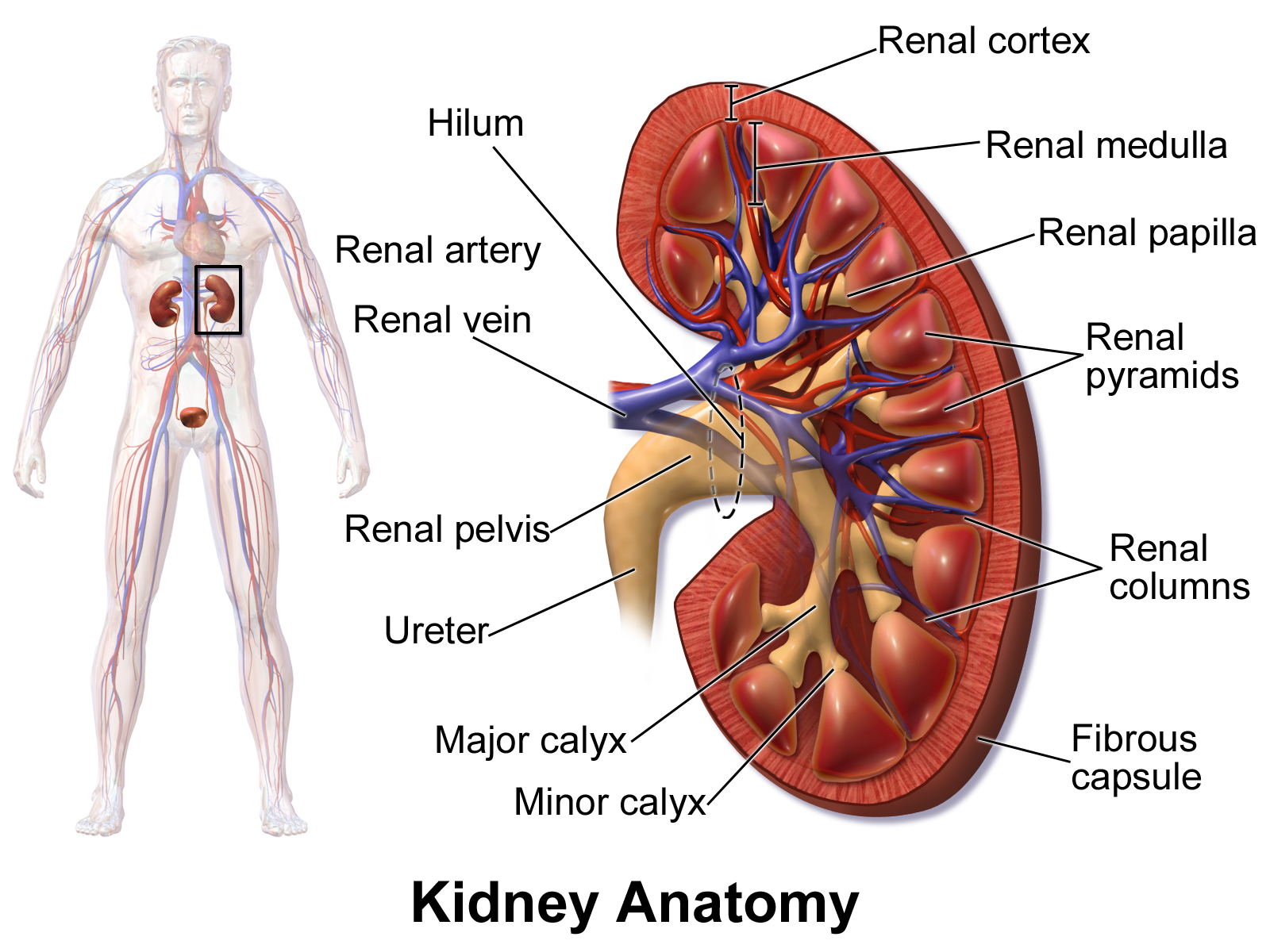
If you cut a kidney in half, you see three main regions:
- Renal cortex: the outer layer, which contains most of the filtering units.
- Renal medulla: the inner part, arranged into cone-shaped renal pyramids.
- Renal pelvis: a funnel in the centre that collects urine and passes it into the ureter.
Blood enters through the renal artery and leaves through the renal vein. The kidneys receive about 20 to 25% of the heart's output every minute, a huge amount for their size.
The nephron: the kidney's filtering unit
Each kidney contains about one million nephrons. Each nephron is a tiny filter-and-tube system with these parts:
| Part | What happens there |
|---|---|
| Glomerulus (a ball of capillaries) inside Bowman's capsule | Filtration: blood pressure pushes water, salts, glucose, urea and small molecules out of the blood into the capsule. Blood cells and large proteins stay in the blood. |
| Proximal convoluted tubule (PCT) | Reabsorbs most of the useful substances back into the blood: about 65% of water and sodium, and normally all the glucose and amino acids. |
| Loop of Henle | Creates a salty environment in the medulla that lets the kidney concentrate urine. The descending limb lets water out; the ascending limb pumps salt out. |
| Distal convoluted tubule (DCT) | Fine-tunes sodium, potassium and calcium, under hormone control (aldosterone, PTH). |
| Collecting duct | Final adjustment of water under ADH control, then carries urine to the renal pelvis. |
How urine is made: three steps
- Glomerular filtration: blood is filtered in the glomerulus. The rate of this filtering, the glomerular filtration rate (GFR), is about 125 mL per minute in a healthy adult (about 180 litres a day). GFR is the best overall measure of kidney function.
- Tubular reabsorption: useful substances (water, glucose, amino acids, sodium, bicarbonate) are taken back into the blood from the tubules.
- Tubular secretion: extra substances are actively moved from the blood into the tubules to be removed, such as hydrogen ions, potassium and many drugs (e.g. penicillin).
Urine = filtration − reabsorption + secretion.
Hormones that control the kidneys
| Hormone | Made by | Effect on the kidney |
|---|---|---|
| ADH (antidiuretic hormone) | Hypothalamus, released by posterior pituitary | Makes the collecting duct keep water, so urine becomes concentrated. Alcohol blocks ADH, which is why it makes you urinate more. |
| Aldosterone | Adrenal cortex | Keeps sodium (and water) and removes potassium |
| Renin → angiotensin II | Kidney | When blood pressure falls, renin starts a chain that makes angiotensin II, which narrows blood vessels and triggers aldosterone release, raising blood pressure |
| ANP | Heart | Makes the kidneys remove more sodium and water, lowering blood pressure |
| PTH | Parathyroid glands | Increases calcium reabsorption |
Normal urine
- Volume: about 1 to 2 litres a day in adults.
- Colour: pale yellow (from a pigment called urochrome). Darker urine usually means dehydration.
- pH: usually slightly acidic, about 6, but can range from about 4.5 to 8.
- Contents: about 95% water, plus urea, creatinine, uric acid and salts.
- Should not contain: glucose (seen in uncontrolled diabetes), protein (a sign of kidney damage) or blood.
Urination (micturition)
When the bladder fills to about 200 to 400 mL, stretch receptors send signals to the spinal cord. The bladder muscle (detrusor) contracts under parasympathetic control, and the internal sphincter relaxes. The external sphincter is under voluntary control, which is why we can usually choose when to go.
Common urinary problems
- Urinary tract infection (UTI): burning, frequent urination; more common in women.
- Kidney stones: hard crystals (often calcium oxalate) that can cause severe pain when passing down the ureter. Drinking plenty of water helps prevent them.
- Chronic kidney disease (CKD): gradual loss of kidney function, most often caused by diabetes and high blood pressure.
- Acute kidney injury (AKI): sudden loss of function, e.g. from severe dehydration or some drugs.
- Benign prostatic hyperplasia (BPH): enlarged prostate in older men, making urination difficult.
- Path of urine: kidney, ureter, bladder, urethra.
- Nephron = functional unit (about 1 million per kidney).
- Urine formation: filtration (glomerulus), reabsorption (mostly PCT), secretion.
- Normal GFR about 125 mL/min (180 L/day). Normal urine output about 1 to 2 L/day.
- ADH = keep water. Aldosterone = keep sodium, lose potassium.
- Kidneys make EPO and renin, and activate vitamin D.
- Kidneys receive 20 to 25% of cardiac output.
- Dose adjustment: many drugs are removed by the kidneys (e.g. metformin, gentamicin, vancomycin, many antibiotics). In kidney disease their doses must be reduced, using creatinine clearance or eGFR.
- Diuretics act on different parts of the nephron: loop diuretics (furosemide) on the loop of Henle, thiazides (hydrochlorothiazide) on the DCT, and potassium-sparing diuretics (spironolactone) on the collecting duct.
- ACE inhibitors and ARBs block the renin-angiotensin system and protect the kidneys in diabetes, but kidney function and potassium need monitoring.
- Nephrotoxic drugs: NSAIDs, aminoglycosides and some contrast agents can damage the kidneys, especially in dehydrated or elderly patients.
- SGLT2 inhibitors (empagliflozin, dapagliflozin) block glucose reabsorption in the PCT, so glucose passes into the urine.
- UTIs: nitrofurantoin, fosfomycin or other antibiotics depending on local guidelines; BPH: tamsulosin relaxes the prostate and bladder neck.
No comments:
Post a Comment